Understanding Athletic Performance as a Dynamic System
In today’s sporting landscape, numerous factors contribute to an athlete’s ability to meet the unique demands and constraints of their sport. Athletic performance is increasingly recognized as a complex, dynamic system in which movement and performance emerge from the interaction of organism, task, and environmental constraints rather than from any single physiological or biomechanical variable (Newell, 1986; Davids, Button, & Bennett, 2008).
Consequently, athletic performance cannot be adequately explained by any single metric, discipline, or school of thought. Instead, performance emerges from the continuous interaction among technical, tactical, physiological, biomechanical, and psychological factors, each of which evolves over time and influences the others. Given this complexity, how can coaches and athletes establish a framework that both explains these interactions and translates them into meaningful training decisions?
Feedback Loops in Motor Learning and Systems Theory
One way to approach this question is through the concept of feedback loops. Rooted in motor learning and systems theory, feedback describes the process through which information generated from movement, the environment, or the athlete's internal state is used to modify future behavior.
Schmidt's Schema Theory and decades of motor learning research have demonstrated that the acquisition of skilled movement depends not only on repeated practice but also on the quality and timing of information available to the learner during and following performance (Schmidt, 1975; Schmidt & Lee, 2019).
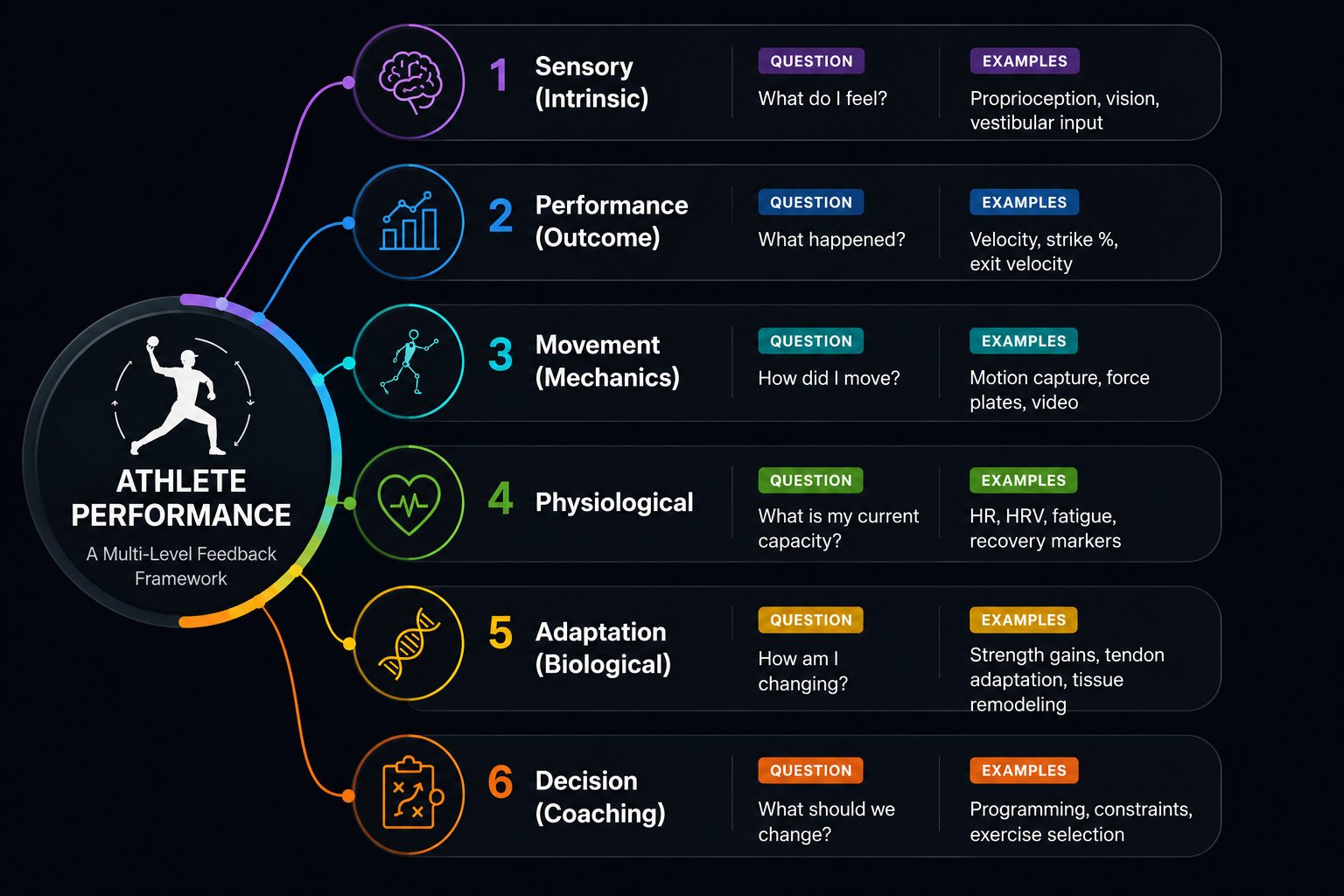
Some of this information is perceived directly by the athlete through intrinsic sensory mechanisms, whereas other aspects require objective measurement through coaches, technology, or physiological monitoring. Regardless of its source, the purpose of feedback remains the same: to reduce uncertainty, refine movement strategies, and improve subsequent decision-making.
Interconnected Feedback Systems Across Multiple Scales
Rather than viewing biomechanics, physiology, psychology, and skill acquisition as independent disciplines, they can instead be understood as interconnected feedback systems operating across multiple biological and temporal scales.
Ecological dynamics proposes that skilled performance emerges through continuous interactions between the athlete and the surrounding environment, with movement solutions self-organizing in response to changing constraints rather than being centrally prescribed (Kelso, 1995; Davids et al., 2008).
Some feedback occurs almost instantaneously during movement execution, whereas other forms emerge over hours, days, weeks, or even years as the body adapts to repeated training stimuli. Together, these nested feedback loops continuously shape movement, influence adaptation, and ultimately determine athletic performance.
Coaching as an Iterative Decision-Making Process
This perspective shifts the role of the coach from simply prescribing exercises to managing information. Every intervention represents a hypothesis, every assessment provides new evidence, and every subsequent decision should be informed by the athlete's response.
In this sense, coaching becomes an iterative process of hypothesis testing in which information gathered across multiple feedback loops is synthesized to reduce uncertainty and optimize future decisions.
Consequently, the quality of coaching is determined not solely by the exercises selected, but by the effectiveness with which relevant feedback is gathered, interpreted, and integrated into individualized training decisions.