Introduction
Over the past decade, force plates have become one of the fastest-growing technologies in sports performance. Once reserved primarily for research laboratories, they are now common in professional baseball organizations, collegiate athletic departments, rehabilitation clinics, and private training facilities. Yet despite their widespread adoption, they remain one of the most misunderstood assessment tools in sports.
Many athletes walk away from a force plate evaluation with pages of data that include peak force, impulse, rate of force development, or reactive strength index without understanding what any of these metrics actually mean and how they can provide direction moving forward.
We, as coaches, often face a similar challenge. Depending on the technology or the number of technologies being integrated, modern software can generate well over one hundred variables from a single jump or isometric test. This makes it difficult to distinguish meaningful information from statistical noise. The problem is not from a lack of data, it is from a lack of context and direction.
Force plates do not directly measure pitching velocity, bat speed, or athletic ability. They measure something far more fundamental: how an athlete interacts with the ground. Every throw, swing, sprint, jump, and change of direction begins with forces exchanged between the athlete and the surface beneath them. Understanding those interactions provides valuable insight into how movement is produced, how physical qualities develop, and how athletes respond to training.
The value of force plate technology, however, reaches far beyond collecting numbers. Its true strength lies in asking the right question, selecting the appropriate assessment, and interpreting the results within the broader context of biomechanics, physiology, and performance. This article introduces a practical framework for using force plates in baseball by answering three simple questions:
What are we trying to measure?
When should we measure it?
How should the information influence coaching decisions?
Rather than focusing on individual metrics in isolation, we’ll explore how force plates fit into an integrated athlete assessment model alongside motion capture, physical screening, and performance monitoring.
Understanding What Force Plates Measure
Before discussing specific tests or metrics, it is important to understand what a force plate actually measures. Whenever an athlete pushes against the ground, the ground pushes back with an equal and opposite force. This interaction is described by Newton’s Third Law of Motion and is referred to as the ground reaction force, or GRF.
Force plates measure these reaction forces at very high sampling frequencies, often between 1,000 and 2,000 measurements per second. Depending on the system, they can quantify forces in three orthogonal directions:
Vertical force: Acting upward and downward
Anterior-posterior force: Acting forward and backward
Medial-lateral force: Acting side to side
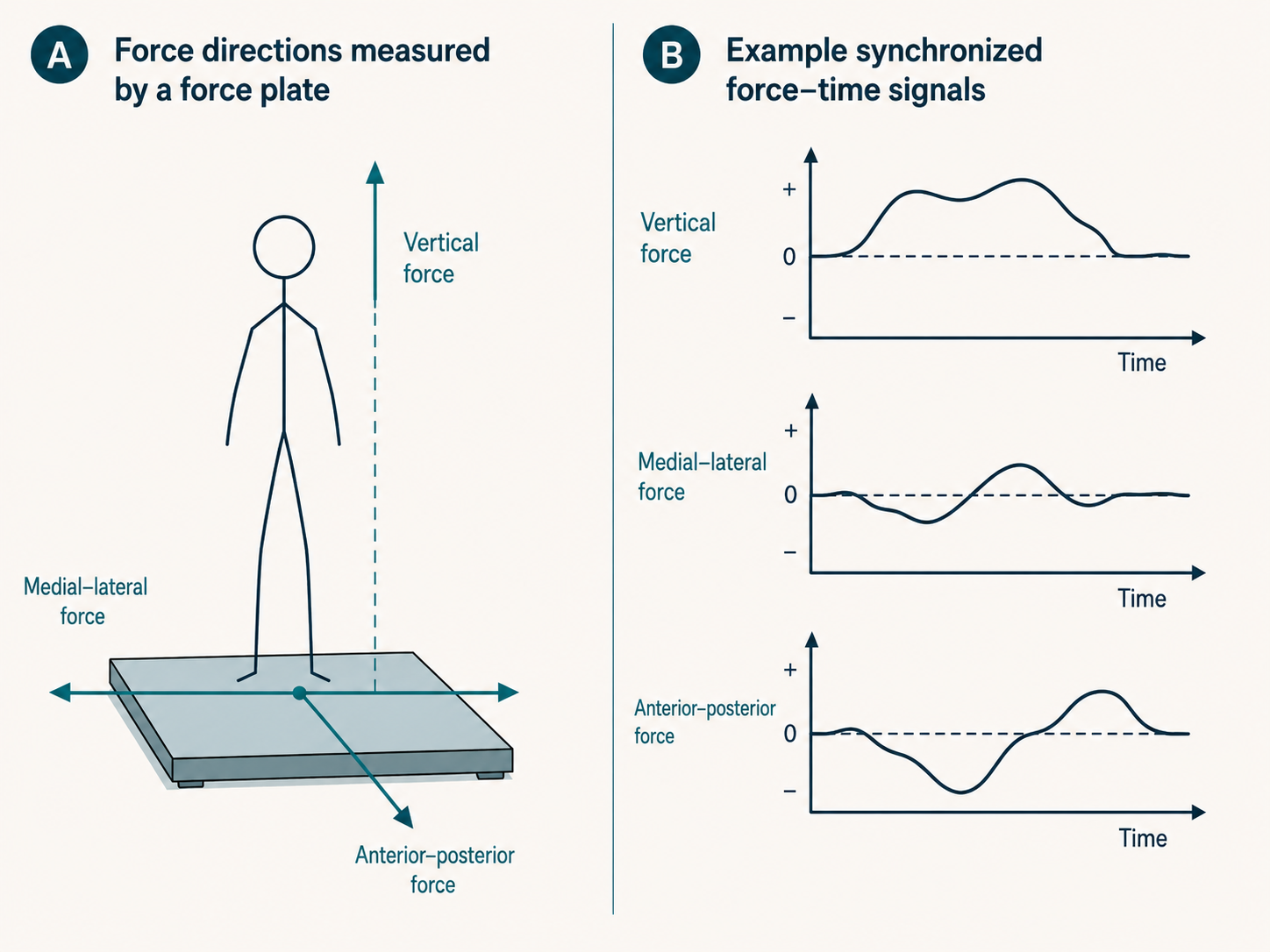
Together, these components provide a detailed picture of how an athlete generates, redirects, and absorbs force throughout a movement. Importantly, force plates do not measure muscle activation, joint angles, or movement technique. They measure only the forces exchanged with the ground. Interpreting those forces requires an understanding of the movement being performed and, ideally, additional information such as motion capture or high-speed video.
Force is Only One Piece of the Puzzle
A common misconception is that larger force values automatically indicate better performance. In reality, the same amount of force can be produced using very different movement strategies.
Imagine two pitchers who generate nearly identical peak ground reaction forces during their deliveries. One efficiently transfers that force through the lower body, trunk, and upper extremity, ultimately producing high ball velocity with minimal mechanical stress. The other achieves the same force but loses energy through poor sequencing and inefficient trunk rotation. The force plate alone cannot distinguish between these two athletes. This illustrates one of the most important principles of performance assessment:
Force tells us what happened at the ground. Motion capture tells us how the body created that force. Performance outcomes tell us whether the strategy was successful. No single technology provides a complete understanding of athletic performance. Instead, meaningful decisions emerge from integrating multiple sources of information.
Two Primary Applications of Force Plates in Baseball
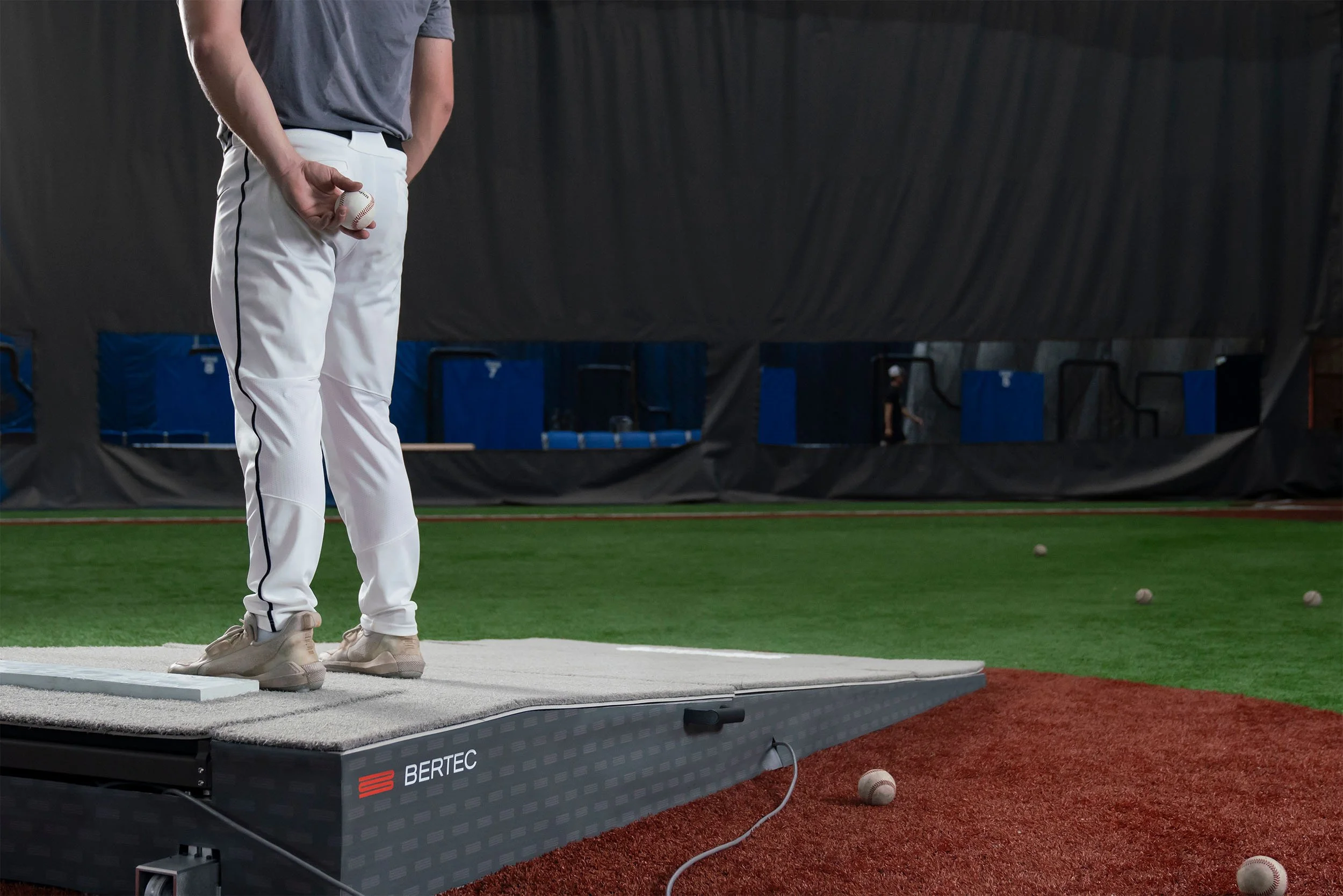
Although the hardware remains the same, force plates are generally used in two distinct ways:
1. Physical performance screening
2. Sport-specific biomechanical analysis
Physical Performance Screening
The first application evaluates the athlete’s underlying physical capabilities through standardized tests that are independent of baseball technique.
Examples include:
- Countermovement Jump (CMJ)
- Squat Jump (SJ)
- Drop Jump (DJ)
- Isometric Mid-Thigh Pull (IMTP)
- Isometric Squat
- Single-Leg Countermovement Jump
- Single-Leg Landing Assessment
- Balance Assessments
These tests answer questions such as:
How much force can the athlete produce?
How quickly can they produce it?
How effectively do they absorb force?
Are there meaningful asymmetries between limbs?
How is the athlete responding to training or fatigue?
Because these assessments are highly standardized, they are useful for tracking physical qualities over time and comparing an athlete to their own historical baseline. Think of these assessments as evaluating the engine rather than the driving technique.
Sport-Specific Biomechanical Analysis
The second application involves synchronizing force plates with technologies such as:
- Three-dimensional motion capture
- Markerless motion capture
- High-speed video
- Ball-tracking systems
- Bat-tracking systems
Here, the objective shifts from evaluating general physical qualities to understanding how force is generated and transferred during baseball movements. During pitching, synchronized force plates can reveal:
- Drive-leg propulsion
- Timing of force production
- Horizontal versus vertical force strategies
- Lead-leg braking
- Center of pressure movement
- Weight transfer throughout the delivery
Similarly, during hitting, they can provide insight into:
- Rear-leg loading
- Front-leg stabilization
- Rotational braking
- Weight transfer
- Timing of force application
Without synchronized kinematic data, force tells us how much was produced. With motion capture, force tells us when, where, and how it contributes to movement. This distinction is fundamental when turning data into practical decisions.
Starting With the Right Question
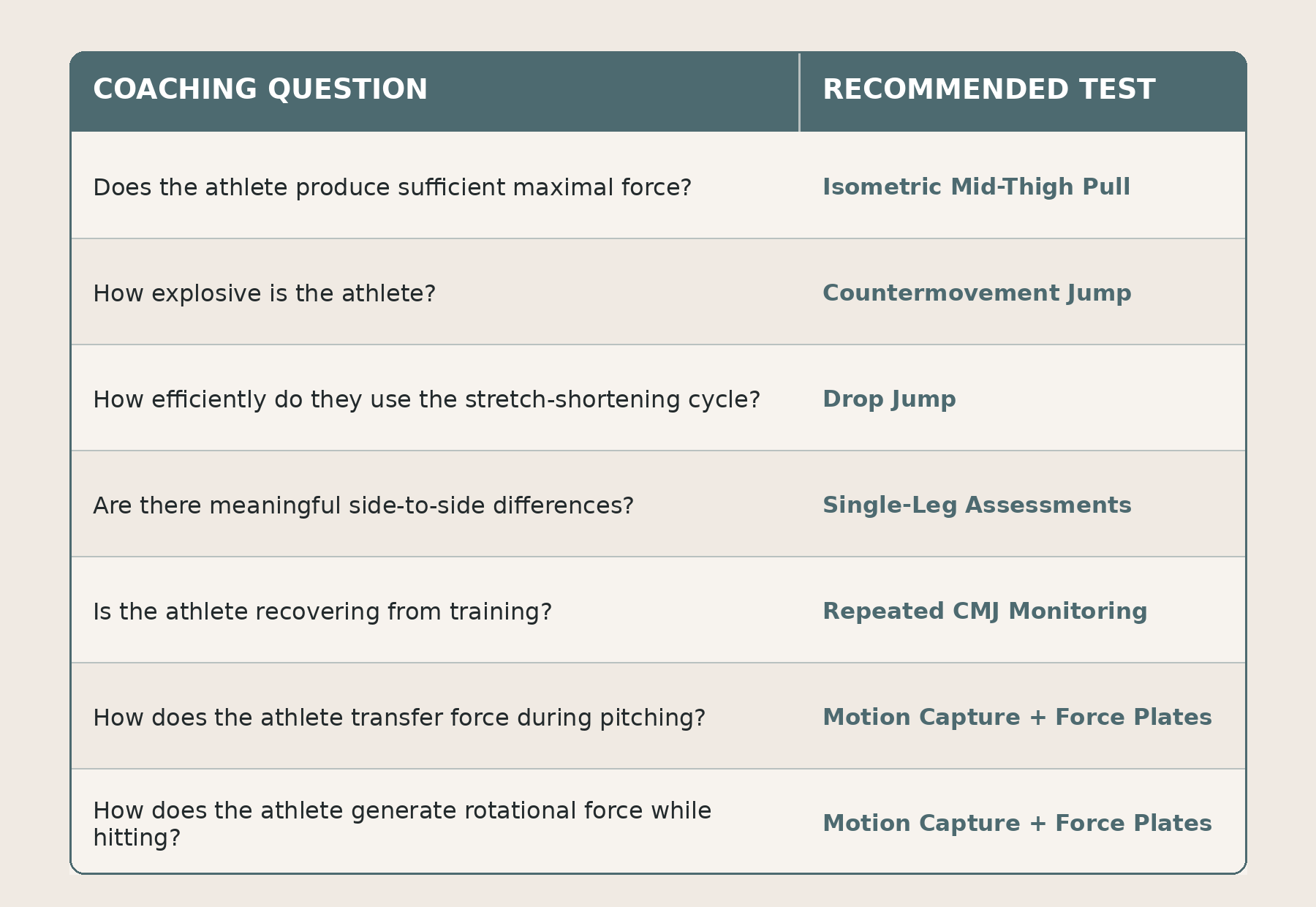
One of the biggest mistakes in force plate testing is selecting a test simply because it is available. Instead, every assessment should begin with a coaching question. Technology should always follow the question, not the other way around.
Coaching Question | Recommended Assessment
What Makes a Good Force Plate Metric?
Modern software may report dozens or even hundreds of variables from a single assessment. While that level of detail can be valuable for research, it often overwhelms coaches and athletes in applied settings. Rather than treating every number as equally important, it is more useful to group metrics according to the physical qualities they describe. Broadly speaking, most force plate variables relate to one of six concepts:
1. Maximum force production
2. Speed of force production
3. Total force applied over time
4. Force absorption and braking
5. Stretch-shortening cycle efficiency
6. Movement strategy
Understanding these underlying concepts is far more valuable than memorizing individual variables. In the next section, we’ll explore the most commonly reported force plate metrics, explain what each one represents, discuss why it matters in baseball, and outline situations in which it can help inform training decisions.
References
Chavda, S., Bromley, T., Jarvis, P., Williams, S., Bishop, C., Turner, A. N., Lake, J. P., & Mundy, P. D. (2018). Force-time characteristics of the countermovement jump: Analyzing the curve in Excel. Strength & Conditioning Journal, 40(2), 67–77. https://doi.org/10.1519/SSC.0000000000000353
Comfort, P., Dos’Santos, T., Beckham, G. K., Stone, M. H., Guppy, S. N., & Haff, G. G. (2019). Standardization and methodological considerations for the isometric mid-thigh pull. Strength & Conditioning Journal, 41(2), 57–79. https://doi.org/10.1519/SSC.0000000000000433
Cormie, P., McBride, J. M., & McCaulley, G. O. (2008). Power-time, force-time, and velocity-time curve analysis during the jump squat: Impact of load. Journal of Applied Biomechanics, 24(2), 112–120. https://doi.org/10.1123/jab.24.2.112
Howenstein, J., Kipp, K., & Sabick, M. B. (2020). Peak horizontal ground reaction forces and impulse correlate with segmental energy flow in youth baseball pitchers. Journal of Biomechanics, 108, 109909. https://doi.org/10.1016/j.jbiomech.2020.109909
Merrigan, J. J., Stone, J. D., Thompson, A. G., Hornsby, W. G., & Hagen, J. A. (2020). Monitoring neuromuscular performance in military personnel. International Journal of Environmental Research and Public Health, 17(23), 9147. https://doi.org/10.3390/ijerph17239147
Teske, L. G., Beck, E. C., Bullock, G. S., Nicholson, K. F., & Waterman, B. R. (2021). Lower extremity biomechanics predicts Major League Baseball player performance. Orthopaedic Journal of Sports Medicine, 9(7), 23259671211015237. https://doi.org/10.1177/23259671211015237